
This encoding was prepared as a component of my undergraduate capstone project for the Textual Studies and Digital Humanities minor program at the University of Washington.
Notes are limited to the names and places listed in the text, however I hope to add more contextualizing and informative annotations in the future.
The goal of transcription and encoding was to preserve as many features of the original text as possible, including damages specific to the volume as it exists in UW's Special Collections. Encoding was tailored to be used in an XSLT transformation to create an HTML document and website styled using CSS in such a way that pages would act as facsimiles to recreate the original reading experience in a digital form.
In the interest of preserving the shape of the text, line breaks are preserved with the appropriate tag. The break="no" attribute is used in lieu of transcribing hyphens when words are split by a line break.

Let us suppose that there was no other star in the universe than our own sun, and let us further, for the sake of making the argument clearer, suppose that the sun was deprived of its system of attendant worlds. Next, let some other object be introduced which we may suppose to be extremely light, like a wisp of vapour, and let it be situated at a distance from the sun which we may regard as indefinitely great. These two bodies, namely, the sun and this wisp of vapour, are then supposed to be abandoned to their mutual attraction. Each of these objects will pull the other, and the result of the attraction between the two bodies will be to make them approach each other. As, however, the mass of the sun is so vast, while the mass of the wisp is so small, we may fairly assume that the greater part of this movement will be done by the wisp, while the sun will remain comparatively at rest. The case is indeed much of the same in this respect as in the fall of a stone to the ground. The stone goes down to meet the earth, but the earth at the same time comes up to meet the stone. As, however, the earth is more massive than millions of millions of stones, the actual movement performed by the earth is in this case quite unappreciable. We may therefore say, with truth enough for all practical purposes, that it is the stone which does all the moving, while the earth remains at rest.
In the same manner we may suppose the sun to be at rest, while the wisp of vapour is drawn towards it from the depths of space. At first, no doubt the motion may be extremely slow: for the attraction of the sun decreases with its distance. Indeed, the wisp of vapour might be so remote, that it would require thousands of years to move over an inch. But as the motion progresses the body will gradually acquire speed, until after the lapse of a time, so long that we shall not attempt to express it in figures, the little object will be found hurrying in towards the sun with the speed of an express train; still the pace will grow until the approaching object will be moving as quickly as a rifle bullet. The intervening distance is now rapidly dimishing; but, as that distance Vol. xxi.-50. lessens, the intensity of the solar attraction increases, and, consequently, the pace at which the object is urged onwards becomes greater and greater. From moving at the rate of a mile in a second, the little object would gradually attain a speed not less than that of the earth in its orbit, namely, about eighteen miles a second. Still the body presses onwards, until a pace could be reached of 100 or 200 miles a second. Finally, when the vapour would be about to make the terrific plunge into the glowing sun, its speed would be upwards of 400 miles a second. The vastness of this speed may be realized from the fact that a body animated by so great a velocity would accomplish a complete circuit of the earth in about a minute.
The case which I have supposed is, however, not exactly that of a comet. The movement would hardly take place in the way just described, in which the sun and the wisp of vapour were both orginally at rest. Such a state of things could hardly be possible in Nature. We may, no doubt, suppose the sun to have been at rest, for it is only the relative movements of the two bodies which concern us. But we can hardly imagine that the wisp of vapour could have been so delicately placed as to have had absolutely no motion whatever, except, indeed, in the direct line towards the sun. If, at the moment of starting, the object posessed a movement which would carry it in the course of time out of the direct line to the sun, then a totally different condition of motion would be the result.
All the time that the sun was drawing this wisp of vapour towards it, the transverse movement would be gradually moving the wisp out of the direct line. Now, though the speed of that movement may be very small, yet in the lapse of those millions of years that are required to draw the body into the sun, this transverse movement will have increased to such an extent that the object will miss the sun instead of hitting it. In fact, after its stupendous voyage from the indefinitely remote depths of space, during which it has acquired its vast speed of scores or hundreds of miles a second, the comet will be found not plunging into the sun, but 394THE STRAND MAGAZINE. passing to one side of it. While the two objects are in such close proximity their mutual attraction is, of course, of tremendous vehemence. In virtue of this attraction, the rapidly moving comet is whirled round the sun, and consequently begins to retreat again towards the same side from which it has come. In this majestic sweep the comet describes a graceful curve. Coming in from infinity it approaches the sun, wheels round the sun, and then again retires to the depths of space.
As the comet has swept in towards the sun, in consequence of the attraction of that body, it may seem difficult to understand why it should then retreat outwards again, notwithstanding the attraction which now seeks to draw it back. This may, however, be illustrated by a very simple contrivance. Let a weight be hung from the ceiling by a string. Let that weight be drawn to aside and then released. It will, of course, swing down to the lowest point, and then, having passed through the lowest point, the weight will begin to ascend. The attraction of the earth pulls the body down, but as it descends it acquires speed, and in virtue of this speed it is enabled to pass the lowest point and to ascend in opposition to gravity on the other side. In the same way, the speed acquired by the comet in its long voyage towards the sun from the depths of space enables it to sweep round the sun without being captured, and then to pass away, perhaps, never more to return. The nearer the comet is to the solar surface the greater is the speed with which it moves, and consequently the more brief is its sojourn in the vicinity of the sun. A comet has, in fact, been known to graze the sun so closely that it passed within one-seventh part of the sun's radius. In this case a period of two hours sufficed for the comet to completely turn round the sun and commence its retreat into space.
The actual circumstances presented in Nature are not quite so simple. We have assumed that the sun and the comet were the solitary objects in the universe. Of course, this condition is not fulfilled. There are the planets surrounding the sun, and then there are the countless hosts of stars. Some of these objects may attract the comet with a vigour sufficient to sway it considerably from the track which it would otherwise follow. In consequence of these various forces we are not justified in discussing the problem actually presented in Nature as being exactly the same as that in the case hitherto supposed. But our illustrations will, at all events, suffice to give a general idea of what actually happens. The comets are drawn in from the depths of space, they approach the sun, they sweep round the sun, and they then retreat again to the abyss from which they have come. The laws of mathematics assure us that it is quite possible for an object, after journeying from an immeasurably great distance for an immeasurably long time, to enter our system, to wheel round the sun and then again retreat to commence an infinite voyage which should last for all eternity. It is perfectly certain that this kind of motion, which we know to be possible does closely resemble that actually performed by many of the comets. These bodies enter our system, they come into the vicinity of the earth, and, under these circumstances, they are accessible to our observation. As they retreat into space they gradually withdraw from our view. Many of the comets which come to visit us appear to be objects which have never been within the ken of the earth before, and which will never be within the ken of the earth again.
There are, however, a few of these bodies which describe orbits of a different kind. They move round in elliptic or oval paths, so that their visits to our vicinity and their consequent visibility to the inhabitants of the earth recur with more or less regularity. Of such a nature is that most famous of all comets, which bears the name of the illustrious astronomer Halley. This splendid object accomplishes a complete circuit around the sun every seventy-five years. It will again display its splendours for terrestrial admiration about the year 1910.
Our knowledge of comets has been greatly extended in the last few years by the application of photographic methods to the investigation of the heavens. Indeed, we are evidently now entering upon a new phase in the history of these mysterious objects. The advantages of photography for such inquiries are obvious. In the first place, the plates present to us pictures of absolute accuracy. This is a matter of special importance in this research, because the appearance of comets changes so incessantly, that unless the portrait of the comet obtained on any particular occasion be absolutely faithful, it is impossible to correct it on any subsequent occasion. Not only from week to week does the comet alter its appearance, but it changes even from day to day. It is, therefore, of the utmost importance to obtain views of the body which shall be of unquestioned accuracy so far as COMETS.395 the aspect of the body is concerned at that particular moment. There is also another reason why photographic pictures of comets are particularly instructive. It is a peculiarity of the sensitive plate that it is able to perceive and record luminous expressions quite too faint to produce any impression on the eye.
When we examine the photograph of a comet, we thus often find on it many details which were quite unseen by the observer, no matter how acute his vision may have been, and no matter how powerful may be the telescope which he as been employing. It is, indeed, sometimes found that the tail of the comet, as it is depicted on the plates, is three times as extensive as the tail of the same body as it is displayed through a telescope.
An interesting comet, which has afforded much occupation to the photographer, was discovered on July 8th, 1893, by Mr. Alfred Rordame, an astronomer residing in Salt Lake City. Mr. W. J. Hussey obtained some admirable photographs of this object at the Lick Observatory, and we are also indebted to the same astronomer for a very interesting account of the physical characteristics of this body.
On looking at the photograph of the comet Rordame, on the 12th of July, and comparing it with that shown on the next page, taken on the following night, the observer will be astonished at the difference in the structure of the two tails. It would seem as if some violent dislocation of the material of the tail must have taken place in the interval which has elapsed between the times the two pictures were taken. There is no doubt that visual observations would never have established this point so clearly as the photographs have done.
It will be noticed that the plates are marked over by numbers of bright streaks: these are the photographs of the
stars which happened to lie in the same field of view as the comet. But it may well be asked how it has come
to pass that the stars are represented by streaks instead of the
round images which we should expect from their sun-like
character. The explanation of this circumstance is not a little curious and instructive. The comet is in
motion, and it moves so rapidly that in the course of such a
protracted exposure as that on July
12th, which lasted for one hour and twelve minutes, the
comet changes its position in the sky through a distance which is
quite apparent. If the camera had been directed throughout the exposure to the same part of the heavens, the
comet, like the unquiet sitter, would only have permitted us to
obtain a very blurred and indistinct portrait. To obviate the effects of this motion it was therefore necessary for
the astronomer who was engaged in taking the picture to
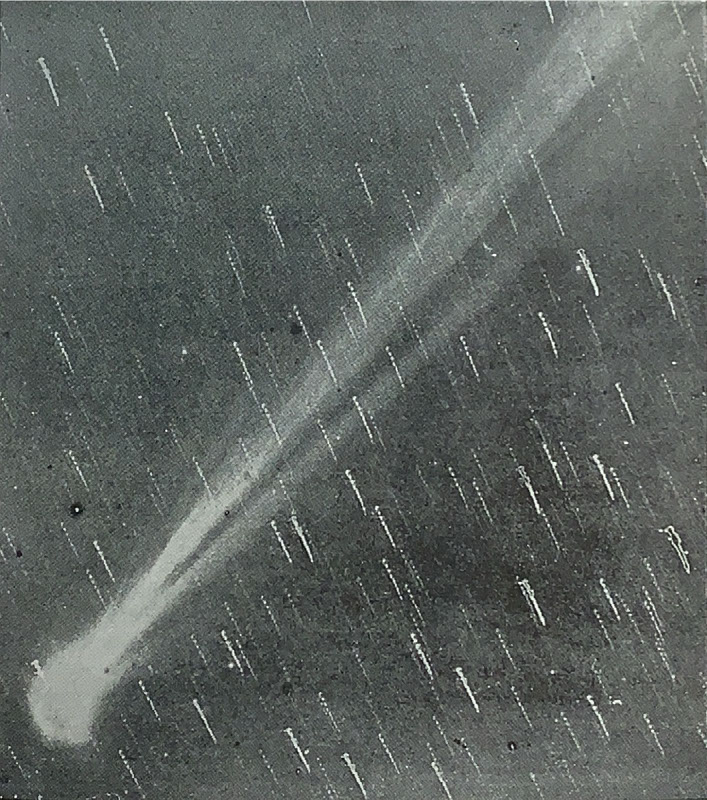 The Comet Rordame, July 12, 1893. 396THE STRAND MAGAZINE.
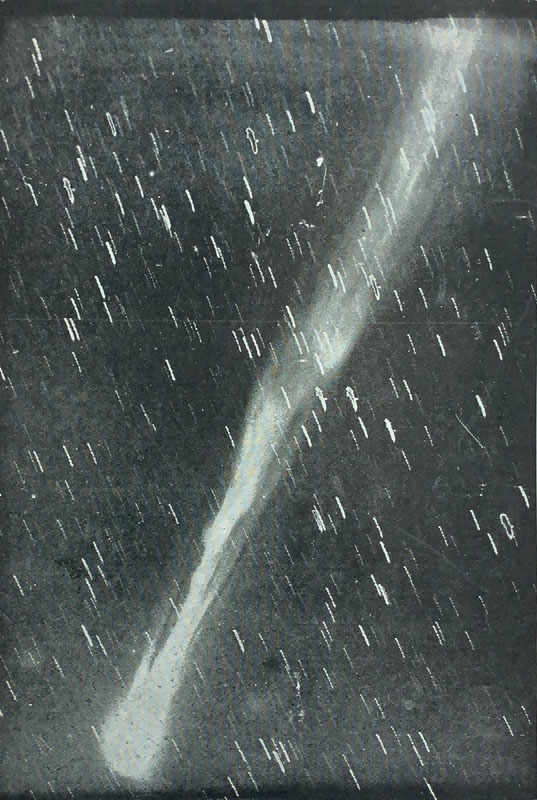 The Comet Rordame, July 13, 1893. shift the camera slowly during the course of the exposure, and in that way to neutralize the
influence of the comet's motion. The picture is thus made to
represent the comet as if that body had remained at rest during the exposure. But the stars which were strewn over
the background remained quiet all the time; as, however, the camera
was shifted, for the reason just mentioned, it follows that each of the stars, instead of being represented by a
point, as it would have been in an ordinary sidereal picture, is manifested in this plate by a streak.
The Comet Rordame, July 13, 1893. shift the camera slowly during the course of the exposure, and in that way to neutralize the
influence of the comet's motion. The picture is thus made to
represent the comet as if that body had remained at rest during the exposure. But the stars which were strewn over
the background remained quiet all the time; as, however, the camera
was shifted, for the reason just mentioned, it follows that each of the stars, instead of being represented by a
point, as it would have been in an ordinary sidereal picture, is manifested in this plate by a streak.
Such streaks, if useless as stellar pictures, are, nevertheless, very instructive. They reveal to us the nature and the extent of the movement of the comet during the period which the exposure has lasted. The length of the streak expresses the apparent distance through which the comet has moved, while the direction of the streak indicates the direction in which the comet is moving. At first sight this latter circumstance may appear somewhat puzzling. We are accustomed to see a shower of sparks extending out behind a sky-rocket, and this tail to the rocket follows generally the track along which the rocket has itself advanced. But the tail of a comet bears a relation to the comet very different from that which the stream of sparks behind a rocket bears to the rocket itself. The position of the comet's tail is governed by the remarkable law that it must be turned away from the sun. In fact, it would generally be found that a line drawn through the comet from the tail to the head would, when continued around the heavens, point to the sun.
In the present case it is plain, from the position of the star tracks, that the motion of the comet happens to be almost perpendicular to the direction of its tail. Considering the very flimsy character of the tail of a comet, it may seem rather surprising that this structure should not be swept backwards so COMETS.397 as to stream out along the comet's track. Especially is this the case when we think of the enormous velocity at which the object is moving. It must, however, be remembered that no atmosphere exists in the open space through which the comet wings its flight. There would be no other medium to offer any resistance to the flight of the tail, and therefore there is no difficulty in explaining how the object moves sideways through space as the photographs show it actually does.
The photographs of Gale's comet shows the rapid
motion of that body in a very instructive manner. The lengths of the
star tracks, of course, exhibit the distance through
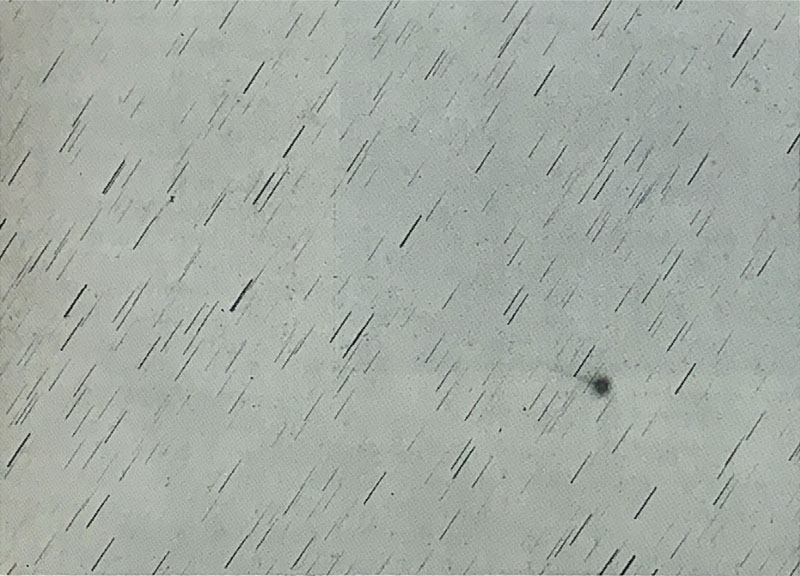 Gale's Comet, May 8,1894. which the comet has moved in the course of a little
more than two hours, which was the duration of the exposure.
Gale's Comet, May 8,1894. which the comet has moved in the course of a little
more than two hours, which was the duration of the exposure.
There is another very interesting circumstance brought out by these photographs of the stars, when we remember that they form a background with respect to the comet. It will be observed that many of the stellar streaks are visible right through the tail. To appreciate all that this implies we should note that most of the stars here concerned are in truth very faint objects. They would, under any circumstances, be quite invisible to the unaided eye. Yet they are nevertheless distinctly seen, notwithstanding the interposition of this stupendous volume of cometary matter. Here, then, we see that stars, even though they be faint stars, can nevertheless be discerned through a thickness of hundreds of thousands of miles, of the material which forms the substance of the tail of the comet. This enormously thick curtain is quite unavailing for the purpose of hiding the stars. Yet the light from those stars is so feeble that the slightest film of haze on a summer sky would suffice to extinguish them. This circumstance shows, in a very striking manner, how insignificant must be the quantity of material which is contained in a comet. We can admit this without, perhaps, going quite so far as to agree with those who assert that the tail of a notable comet may, nevertheless, contain no greater quantity of solid material than could be packed into a portmanteau.
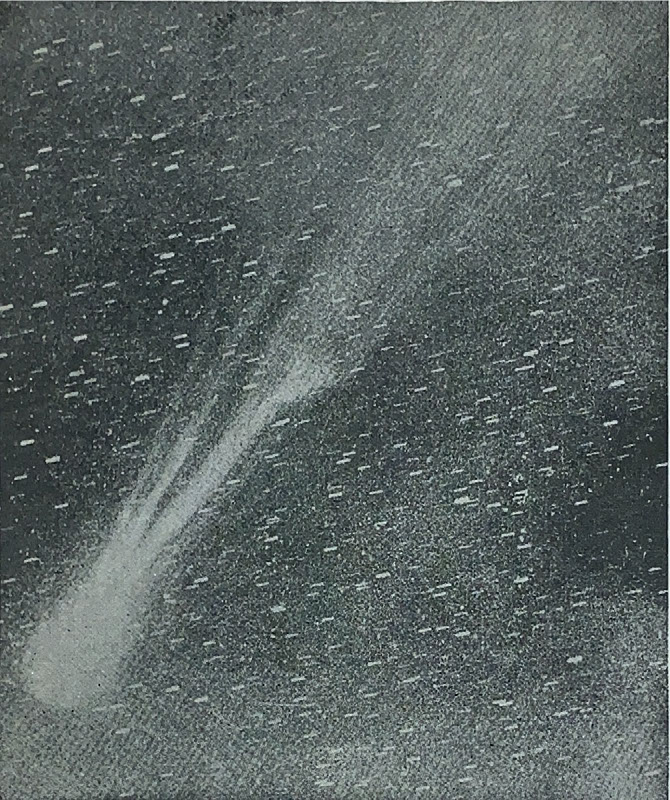
The comet discovered by Swift in 1892 is a very interesting and instructive object. The picture shown on the next page was taken by Professor E. E. Barnard, at the Lick Observatory, on 7th April, 1892. This comet posesses a feature which may be said to be without a parallel in the photographs of any other similar object. It displays the actual formation of a second comet as a part of the first. It can hardy be doubted that this second comet is destined to assume an independent existence. Astronomers had already known, in the case of Biela's comet, that one of these objects divided into two. Here the operation of division may actually be witnessed.
The remarkable movements of all comets, and the brilliant appearance which many of these objects display, make every circumstance with regard to them of much interest. It will, therefore, not be a matter of suprise to learn that the spectroscopic methods of research, which have already taught us so much with regard to the sun and the stars, have been applied to the examination of comets. The results are very instructive, and we here give some account of them.
 Swift's Comet, April 7, 1892.We must first explain that there are two totally different ways in which a body may be rendered visible. In the first case, it may shine by its own
light; in the second case, it may simply show the light reflected
from some other luminous body. The illumination dispensed by a sun or a star is of the first kind; that shed by
the earth or any other planet is of the second kind. The first question which we have to ask with regard to the
light received from a comet may be thus stated. Is this light due to
some cause of luminosity in the comet itself, or is it merely sunlight reflected from the comet as from a planet?
Swift's Comet, April 7, 1892.We must first explain that there are two totally different ways in which a body may be rendered visible. In the first case, it may shine by its own
light; in the second case, it may simply show the light reflected
from some other luminous body. The illumination dispensed by a sun or a star is of the first kind; that shed by
the earth or any other planet is of the second kind. The first question which we have to ask with regard to the
light received from a comet may be thus stated. Is this light due to
some cause of luminosity in the comet itself, or is it merely sunlight reflected from the comet as from a planet?
If we had been restricted to the use of telescopes, however powerful, it would hardly have been possible for us to have solved this problem. The spectroscope has, however, the power of disentangling the component rays in a beam of light, and thus indicating their character in such a way as enables us to learn what the source of the light may have been. We thus find that the light emitted from a comet is, generally speaking, of a two-fold character. Part of it is undoubtedly reflected sunlight. This is demonstrated by observations with the spectroscope, which show that part of the radiation from a comet exhibits a continuous spectrum, marked by precisely those lines and groups of lines which are distinctly characteristic of sunlight. The evidence on this point is quite convincing. We should, indeed, have been greatly surprised had it been otherwise; for when the comet adventures so near the sun as it does in the course of its wanderings it must be brilliantly lighted up by the great luminary, and, of course, some portion of the splendour thus produced is naturally reflected to us.
But besides the brightness which comets possess in virtue of the sunlight which they receive, it is quite certain that they are also to be regarded as being in a certain sense light generators themselves. In this respect the comet is at once perceived to be a body of a totally different character from a planet. The splendour of Venus is due simply to the sunlight which falls upon it. Nor does the great Jupiter himself emit any rays beyond those which he imperfectly reflects from the sun. The comet is, however, of a very different nature from the more robust planets. Part of the light which the comet transmits is unquestionably due to incandescense in the body itself. If the sun were to be suddenly deprived of light-giving power while we were surveying the heavens containing the moon and a planet and a bright comet, then the moon and the planet would instantly disappear from view; but the comet might still shine on. No doubt it would lose some of its brightness, and probably the tail would be to a great extent shorn of its original proportions. There would, however, be a certain amount of cometary light independent of the sun still forthcoming, so that extinction would not necessarily overtake the comet as it certainly would the moon and the planets.
The spectroscope not only tells us of the COMETS.399 existence of light intrinsic to the comet, but its evidence goes much further; it informs us actually as to what the very elements must be to whose presence in the comet the light owes its origin. We here note the peculiar advantage of the spectroscopic methods of research. They detect special differences in the rays of light, thus often enabling us to trace each different type of light to its source.
The first notable achievement in the determination of the peculiar character of the radiation from a comet was made by Dr. Huggins in 1868. He showed that some of the rays of a comet which appeared that year were indicative of the presence of the element carbon in the body of the object. In the case of this particular element the available information carried us somewhat further than is often the case. Not only was the existence of the element demonstrated, but the particular chemical combination in which that element appeared was disclosed. By its union with hydrogen, carbon gives rise to an important series of compounds. The substances thus produced are very familiar. It need only be mentioned that the common petroleum, which we use in our lamps, is a combination of carbon and hydrogen! The spectrum of a hydro-carbon, as one of these compounds is termed, is of such a characteristic nature that it can be used as a test to show whether the hydro-carbon itself is present. Dr. Huggins compared the spectrum of the comet now referred to with the spectrum of these hydro-carbons. The identity between the two spectra was noted, and thus a splendid addition was at once made to our knowledge. Subsequent research has confirmed the important discovery that hydro-carbons are characteristic components of many comets.
For many years no further important addition was made to our knowledge of the elementary substances present in these wandering bodies. The light they dispensed appeared to be partly the reflected light from the sun, and partly the light due to incandescent hydro-carbons. But in 1882 a great advance was made. A comet was discovered that year in Albany, by Mr. Wells. At first, this body showed the bright continuous spectrum due to reflected sunlight, while the indications of the presence of hydro-carbon were mainly confined to the neighborhood of the nucleus. After this interesting object had adorned the heavens for a couple of months Dr. Copeland, now the distinguished Astronomer-Royal of Scotland, discovered a bright yellow line in the spectrum indicating the presence of sodium. This observation was of particular importance, inasmuch as it afforded at once direct evidence of the presence in these celestial wanderers of another element specially remarkable in its terrestrial relations. An emphatic confirmation of Copeland's discovery was presently forthcoming. It is well known that the bright yellow line indicative of the presence of sodium is seen to be double when examined under suitable circumstances. As the comet approached the sun the characteristic sodium light became quite strong. The nucleus glared with the distinct yellow hue belonging to this element; and, indeed, by filtering away all other light in a process with which a spectroscopist is familiar, an outline of the head of the comet was obtained which was produced by sodium light alone.
To Dr. Copeland and Dr. Lohse at the Earl of Crawford's observatory in Dunecht we are also indebted for yet one more important addition to our knowledge of the composition of these bodies. In the autumn of 1882 we were visited by another comet, which must rank as one of the most famous of these objects which have appeared during this century. On the 18th September, 1882, the two astronomers I have named observed in the spectrum of this comet, not only the sodium line, but also six other lines. The places of these were carefully measured, and it was found afterwards that they were undoubtedly the chief lines of the iron spectrum. Here was, indeed, another notable discovery. The element iron, of such transcendent importance to us on the earth, is now known to be a constituent of the cometary wanderers throughout space.
Thus we have learned that the principal elements in comets are among the common substances on the earth. Here, again, we find additional testimony to that fundamental unity in the composition of heavenly bodies, the perception of which is one of the most notable results in modern science.